Hatfield Brothers Reunion
Boone, Iowa, October 1915
L to R: Hiram V Hatfield, Albert W Hatfield, Martin Monroe Hatfield, Henry S Hatfield
Hatfield Brothers Reunion
Boone, Iowa, October 1915
L to R: Hiram V Hatfield, Albert W Hatfield, Martin Monroe Hatfield, Henry S Hatfield
Where to Find a Cause of Death
For years I searched for death dates for my ancestors. Death dates were found in family records, bible records, headstones, obituaries, death records, etc. The death dates were not always combined with a cause of death. And, if cause of death was mentioned, I did not always pay attention and record the cause. I have since repented of my negligent ways and always try to find a cause of death, as well as the date of death.
Mortality Schedules
Mortality Schedules were included in the 1850, 1860, 1870, and 1880 US Federal Censuses. The mortality schedules asked questions regarding those who died in the twelve (12) months prior to the census enumeration. During the 1850 to 1880 time period, the mortality schedules are among the best sources for cause of death if your ancestor happened to die in the year leading up to the census.
My 4th great-grandmother, Sarah McNeil, died in March prior to the census being taken on June 1st, 1860. She is shown in the Parke County, Indiana 1860 Mortality Schedule on page 41, line 24. Information given: Name: Sarah McNeal; Age: 60; Female; Born: Virginia; Died: Mar 1860; Cause of death: Consumption; Sick 14 days.
![]() |
| 1860 Mortality Schedule, Parke County, Indiana, line 24 Sarah McNeil, 4th Great-Grandmother Died of Consumption |
Death Records
Of course, the best place to find a cause of death is a death record/certificate. Most states did not start recording deaths until the early 1900's, although some local health departments in larger cities began recording deaths in the mid-1800's. Most of our ancestors lived on the frontiers of Oklahoma and Texas in the late 1800's and early 1900's. Death certificates were not widely available in Oklahoma and Texas until the 1920's and sometimes even into the mid 1930's - especially in Oklahoma. Thankfully by 1938 there was a death certificate for my grandmother's (Mabel Leffel Baldwin) cousin, Florida Tucker Stanford Leffel. Her death certificate solved a big mystery, read about it here.
| Death Certificate for Florida Melissa (Tucker Sanford) Leffel Florida died of acute coronary occlusion |
![]() |
| James M Baldwin died of pneumonia on 11 Feb 1905 Robertson County, Texas Record of Deaths, Vol 1, pg 8 |
Obituaries
Sometimes an early obituary might mention a cause of death (but often times not). The example below of the 1891 obituary for my 3rd great-grandfather, James Wilson (1814-1891), mentioned his cause of death as "tumor of the stomach".
| James Wilson Obituary The Democrat. (McKinney, Tex.), Thursday, April 9, 1891 |
| Mrs. John Martin and daughter, May, died of Measles. 11 March 1903, Rock Island Argus and Daily Union, pg 8 |
| Britton Medlin died when a tree limb fell on him. Republican Banner, Nashville, TN; Monday, April 14, 1845 |
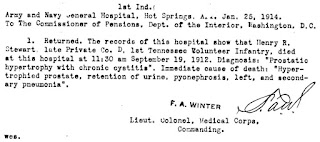
| Henry R Stewart death record Civil War Pension File |
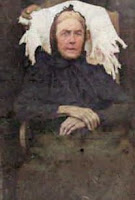
Sarah Margaret Cole McNeil
1826-1905
| Sarah Margaret Cole McNeil 1902 |
Sarah Margaret Cole, the daughter of Nathan Cole and Anna Margaret Goble, was born 21 February 1826, in Sullivan County, Indiana. Her birth, along with births of her husband and children, was recorded on a sheet of paper that was tucked in an old family bible.
While Sarah's obituary states she was born in Sullivan County, Indiana, I have never found any records indicating that the family actually lived in Sullivan. All records for Sarah's parents are found in Parke County, Indiana. Sarah was living in Parke County, Indiana when she met William S McNeil. She was 21 years old when she and William married on 17 October 1847 in Parke County, Indiana by Justice of the Peace Scott Noel. .
| William S McNeil and Sarah M Cole Marriage Record Parke County, Indiana |
The young couple continued to live in Parke County until about 1854 when they moved to Taylor County, Iowa. In the 1856 Iowa State Census, William and Sarah are enumerated in Ross Township, Taylor, Iowa. William and Sarah have two children, S.A. (Susannah Amanda) and T.C. (Thomas C.). An older daughter, Eliza Jane, had previously passed away.
| 1856 Iowa State Census, Ross Township, Taylor County Wm S McNeil Family |
Sarah's youngest brother, Timothy Cole, is living in the household with them. Next door to the McNeil family was Sarah's sister, Abigail Cole Stine, and her family.
William and Sarah moved again a few years later. By 1860, they were living in Nodaway County, Missouri. The census shows that two more children were added to the family: Rocksa (Roxie Ellen) and Nancy (Nancy Abigail). The family is still in Nodaway County, Missouri for 1870 Federal Census. The post office given in the census is Maryville. Two sons more sons had been born into the family: Nathan H. and James H.
In 1878, the family moved to Smith County, Kansas. William homestead land in Harvey Township, Smith County, Kansas. William and Sarah remained in Kansas the remainder of their lives.
William died on 5 February 1894 and was buried in the Cedar Cemetery. Sarah has not been found in the 1900 census, but was most likely living with her son, Nate. In 1902, the McNeils had a family reunion. The following newspaper notice for the reunion was published in the Smith County Pioneer newspaper.
| 1902 McNeil Reunion |
As mentioned in the above newspaper article, the family had their picture taken by Photographer Stone. Below is a colorized version of the family group photo.
| McNeil Family Reunion 1902 |
| Grandma McNeil and her children 1902 |
| Sarah M Cole McNeil 1902 |
| Smith County Pioneer Newspaper 9 Feb 1899 |
This day, one hundred eighty-six years ago, was an eventful day in our family's history. The Battle of the Alamo took place on March 6, 1836.
Our Sadler and Lindley ancestors made the move from Illinois to Texas in 1833. They, along with many other colonists living in Texas, were accustomed to the freedoms they had enjoyed previous to moving into Texas and were not happy with Mexico's increasing dictatorial attempts.
| Texas in Revolution 23 Oct 1835, Richmond Enquirer, pg 4 |
By the latter part of 1835, the Texians were engaging in battles and revolting against the Mexican government. Our family's Jonathan Lindley was part of this movement of revolt.
Jonathan Lindley joined Capt. Carey's Company in the regular Texas Army in the fall of 1835. Jonathan then participated in the Battle of the Bexar on December 14, 1835, in which the Texians captured the city of San Antonio de Bexar and fortified the Alamo into a fort. Afterwards, Jonathan and many others returned home for Christmas hoping that the Revolution was over. At some point in time after the first of the year, Jonathan returned to help defend the Alamo.
| Alamo Battle - Texas State Archives |
On February 23, 1836, a Mexican army commanded by General Santa Anna began a siege of the Alamo. The siege lasted for 13 days. At dawn on March 6, 1836, Santa Anna's Mexican assault troops stormed the Alamo and overpowered the Texians. All the defenders of the Alamo, about 189 men, were killed in the battle, which lasted about 90 minutes. After the battle, Santa Anna had the bodies of the dead stacked and burned.
| Battle of the Alamo |
During the siege, on March 2, 1836, a congress of Texians convened at Washington-on-the-Brazos and declared Texan Independence from Mexico. News of the Alamo's fall, prompted many to join Sam Houston's army and fight for Texan Independence. On April 21, 1836, the Texan Army attacked Santa Anna's army at San Jacinto. The battle, which lasted only 18 minutes, was a victory for the Texans. The battle cry for the Texans was "Remember the Alamo!"
| The Alamo |
| Alamo |
Related Posts:
Jonathan
Lindley - Defender of the Alamo
From FamilySearch.org:
Join us at RootsTech
The World’s
Largest Family History Conference
100% Virtual, 100% Free
3–5 March
2022
Sign up
for RootsTech so you can enjoy:
From me:
If you are interested in taking your genealogy to the next level be sure to register for the RootsTech Family History Conference by FamilySearch.org -- it's FREE. And it's virtual, so you can attend in the comfort of your own home!!
I have been attending RootsTech from it's inception in 2011. In past years, I would need to pay a registration fee, travel to Salt Lake City, and stay in a hotel -- a lot of time and cost involved. But, it was always worth it! Over the years of attending RootsTech I learned so much to help me in my family history.
Sign up for RootsTech 2022. Learn from your favorite family history experts, listen to inspiring keynote speakers, attend the virtual Expo Hall, and participate in Relatives at RootsTech to see how you may be related to other RootsTech attendees. Over a 100,000 participants have signed up for Relatives at RootsTech. Maybe you will find out that we are relatedπ
A Guide to Navigating the RootsTech 2022 Website
According to AncestryDNA, a DNA community is a "group of people who share DNA because their relatives recently lived in the same place at the same time." Whereas ethnicity regions (shown in previous post) go back 500 years or more, DNA communities are more recent - 50-300 years. MyHeritageDNA also offers something similar called "Additional Genetic Groups". Both AncestryDNA Communities and MyHeritageDNA Genetic Groups align with my known ancestral locations.
AncestryDNA Communities
MyHeritageDNA Additional Genetic Groups
Since most of my ancestors have been in this country for 200-300 years, these Communities/Genetic Groups represent places my ancestors lived once they were in America. In 2017, I compiled a list of my known immigrant ancestors and where they were from. My ancestors who came over in the 1600s came mainly from England and settled in New England. By the early 1700s, they were also immigrating from Ireland. A lot of those ancestors settled in Pennsylvania. Then all of those early New England ancestors started moving south and west during the later part of the 1700s. During the 1700s, a second wave of immigrant ancestors started arriving in Maryland, Virginia, North Carolina, and South Carolina. This last group then moved into Georgia, Tennessee, Alabama, Kentucky, and Mississippi.
The following pedigree is of the birth places for four generations of my ancestors. Most of my ancestors in the fourth generation back (excluding my German lines) were born in the southern states during the first half of the 1800s. One generation farther back (not shown on the pedigree), most of the ancestors were from Georgia, South Carolina, North Carolina, Virginia, and Tennessee.
| 4 Generations of Birth Locations of Ancestors |
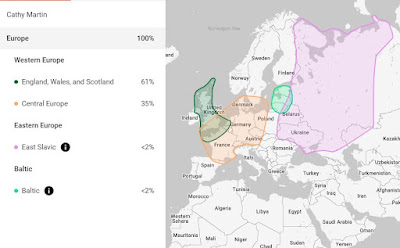
Back in 2012 I started testing my DNA at AncestryDNA, FamilyTreeDNA, and 23&MeDNA. In a 2013 post, I compared the ethnicity estimates given by the three companies. Click here to view the 2013 post. Since those initial results, my ethnicity results have changed a little but not much. Below are my current estimates given by the four major DNA companies that I now work with.
AncestryDNA Ethnicity Estimate
| Last Updated September 2021 |
Family Tree DNA myOrigins
| Christmas Dinner 1896 loc.gov |
Related Posts:
50th Wedding Anniversary
Martin and Alma Barnes
![]() |
| 1977 Wedding Anniversary article, unknown newspaper |
| Colorado State Marriage Record |
For many years I ordered microfilm from FamilySearch to view at my local Family History Center. Now most of those records can be found online at FamilySearch.org. Whether it's 2:00 pm or 2:00 am, I can now search through those digitized records in my own home. What a blessing this milestone is for all genealogists!
The following is from FamilySearch:
Okay, so this isn't a direct ancestor, but it was a great find! I only wish I could find a newspaper article with this much information on a direct relative. But, Annie Johnson is part of my family treeπ.
Not only does this news article give information about Grandma Johnson (nee Annie McKinney), but also about her husband's Civil War days. Annie Johnson's husband was John Alfonzo Johnson, referred to as "J A" Johnson. He was the first cousin of my Great-Grandma Caldona Jane Box Leffel and that makes him my first cousin 3X removed.
| The Hamblin Herald, Hamblin, Texas, 23 Nov 1923 |