Thursday, July 14, 2016

Indentured Servant: Anthony Chamness

Anthony Chamness
Indentured Servant

Anthony Chamness is my seventh great-grandfather on my Minnie Pearl Hatfield line (Hatfield-Jay-Hockett-Reynolds).
A history of indentured servitude in the American Colonies given at end of this post.

Our ancestor, Anthony Chamness, came to America in 1724 as an Indentured Servant.  While some family legends can be found online stating that Anthony was lured, kidnapped, or stowed-away to the American Colonies, it appears that Anthony instead came as an indentured servant.   

Anthony Chamness, son of John Chamness and Ann Weary, was born on February 17, 1713.  Anthony was baptized when he was 18 days old at St. John’s Church of Wapping.  (Wapping is a district of London situated on the north bank of the River Thames.) 

Anthony Chamness Baptism Certificate

A record of Anthony’s indenture gives the following information.
  On February 9, 1724 he was indentured to John Cooke of London as a bond servant for 7 years. His home is listed as White Chapel in Middlesex County, which lies just east of Wapping. His destination was Maryland. The indenture lists his age as 15, but according to his birth date he was just turning 11 or 12 -- depending on whether the Julian or Georgian Calendar was used.
Below is a copy of the Anthony Chamness indenture.  

Indenture for Anthony Chamness 1724
Transcription of above indenture:

"London the Ninth day of February One Thousand, Seven Hundred and 24
"Memorandum, That Anthony Chamness of White Chapel in County of Middlesex did by indenture bearing like date herewith, agree to serve John Cooke of London Vichular or his assigns seven years, in Maryland (his Majesty's Plantation in America) and did thereby declare himself to be of the age of fifteen years, a single person, and no covenant or contracted servant to any other person or persons. And the said master did thereby covenant at his own cost, to send his said servant to the said plantation; and at the like costs to find him all necessary clothes, meat, drink, washing, and lodging, as other servants in such cases are usually provided for, and allowed."
Jurat 9 Feb. 1724 Coran (?)
The Mark of Anthony Chamness (circle with dot in the middle)
Witness"

Since the indenture presumably began in 1724 when he arrived in America, Anthony would have completed his 7 years indenture and become a free man in about 1731 when he was about 18 years old.  Sometime in the next few years, Anthony met Sarah Cole.  They married on Thursday, November 24, 1735, in St. Paul's Parish, Baltimore County, Maryland. 

Sarah was the daughter of Joseph and Susanna Cole. Her father, Joseph had died in 1720, leaving land to Sarah in Baltimore County.  One family legend states that all Anthony and Sarah had to start out their marriage was a broken wooden bowl in which she could mix her bread, and a wooden spoon Anthony made. These two articles comprised their kitchen equipment.  
Below is a photo of a broken wooden bowl that may look similar to the one our Sarah Chamness used.  The bowl pictured is circa 1710 and is from the National Park Service website of the Saratoga National Historical Park.  
Photo of broken wooden bowl circa 1710 -  National Park Service 

Early in their marriage, Anthony and Sarah converted to the Society of Friends – more commonly known as Quakers.  The Chamness family records can be found in the Monthly Meetings of Gunpowder (Baltimore County), Monocacy (Frederick County, Maryland), Fairfax (Virginia), and Cane Creek (Orange County, North Carolina).

Anthony and Sarah moved their family to North Carolina when he received a land grant of 490 acres lying on Cane Creek on June 24, 1751.  The area of Cane Creek was originally in Orange County but eventually became Alamance County.
Cane Creek Monthly Meeting Record
Anthony and Sarah were the parents of the following children: Elizabeth, Susanna, Joseph, Sarah, Mary, Martha, John, Anthony, Rachel, Ann, Lydia, Joshua, Stephanus.

One biographer of Anthony and Sarah stated the following:
"For many years in the early history of Cane Creek Monthly Meeting, the name of Anthony Chamness may frequently be found on committees. This shows that he was regarded as a man of integrity and good judgment and worthy to be entrusted with the work of the church. He was industrious and frugal, sociable, and given to much hospitality. He and his sons worked hard, cleared out a large farm, and put it in a good state of cultivation; and Sarah, the good wife and mother, taught her daughters to spin and weave and to many kinds of work now done only in factories."

Anthony's wife, Sarah died in about 1765.  Anthony married a widow, Rachel Haworth, in 1766.  After Rachel died in 1775, Anthony married Margaret Williams, a widow aged 56. 
Anthony died on September 20, 1777. 
Anthony and Sarah were buried at the Cane Creek Monthly Meeting Cemetery, Snow Camp, North Carolina.


Anthony Chamness Will - transcription below

Anthony Chamness Will
Transcription of will:
November 24, 1776
This twenty fourth day of the eleventh month, commonly called November, in the year of our Lord, one thousand seven hundred seventy and six; Being in health of body and of perfect mind and memory blessed by God, and knowing that it is appointed for all men once to die, I do make and ordain this my last will and testament, and as touching our worldly estate as it hath pleased God to bless me with. In this I give devise and dispose of in manner following:
First, I ordain and constitute my eldest son Joseph Chamness to be my only and soal executor of this my last will and testament: I allow my charges and just debts to be first paid out of my estate: Also I give and devise to my son, John Chamness, all the parcel of land whereon he now lives. Beginning at Betty Mayners south east corner running thence south to Richard Kemps corner thence west along Kemps line to the petition fence; thence of strait course to Betty Mayners line containing less or more to be freely possessed and enjoyed by him his heirs or asigns forever...
Also, I give to my son Joshua Chamness the remainder part of my land that I now live on to be freely possessed and enjoyed by him his heirs or asigns forever. But if my son Joshua should decease without an heir lawfully begotton of his body then his share of land to be sold and the money to be equally divided between my sons Joseph and Anthony. I also give to my son Joshua one feather bed furniture and bedstead the waggon and all the geers and the three dark creatures with all the plantation tools as two plows and an iron toothed harrow axes mattocks and hoes and as the working tools belonging to the plantation with chears table and chest and his and yearling the puter tankard fire tongs and shovel and the largest pot and hooks and rack.
I also give and devise to my daughters Ann Chamness the feather bead furniture and bedstead that was called Elizabeths and the cow bell story and her from this time with three puter basons and four puter plates and one puter dish. I also give and devise to my daughter Rachel Under three puter plates and two puter basons...I give to my daughter Susannah Reynolds five shillings. I also give to my daughter Sarah Vestal five shillings...I also give to my daughter Mary Davis five shillings...I also give to my daughter Martha Hussey five shillings. I also give to my son Anthony Chamness my worsted suite and best hat and tea kettle...I also allow the rest of my cattle to be equally devided between my two sons Joseph and Joshua...I a-lso allow my sheep to be equally devided between my son Joshua and his step mother and the gees and the rest of the fowls with the hogs after they have been killed their winters meat all to be equally devided...I also allow her to have the half of the grain that is raised on the plantation until my son Joshua comes to age and after he comes to age if she pleases to live with him and to do for him and he pleases to let her then she may have the third of what is raised the flax also to be devided he is to it and she to make it ready for wearing. I also allow her all the goods and chattles that she brought here that was her former husbands to be her own and my children to have no flame there....I also give to my daughter Lydia Ward the case of drawer the puter quart and fine flacks. I allow Sarah Wheeler to have the one black cow unmarked or puter dish the coffy pot and cannaster and a tin spin box and a large puter bason all that was called her grandmothers.
In witness and testamony I Anthony Chamness do hereunto set my hand and seal the day and year first above written. Signed and sealed in the pressence of his
William Marshill
Joseph Cloud
Jacob Marshill
His Mark Anthony X Chamness

Indentured servitude 
in the American Colonies

From pbs.org History Detectives
Indentured servants first arrived in America in the decade following the settlement of Jamestown by the Virginia Company in 1607.  The idea of indentured servitude was born of a need for cheap labor. The earliest settlers soon realized that they had lots of land to care for, but no one to care for it. With passage to the Colonies expensive for all but the wealthy, the Virginia Company developed the system of indentured servitude to attract workers. Indentured servants became vital to the colonial economy.
The timing of the Virginia colony was ideal. The Thirty Year's War had left Europe's economy depressed, and many skilled and unskilled laborers were without work. A new life in the New World offered a glimmer of hope; this explains how one-half to two-thirds of the immigrants who came to the American colonies arrived as indentured servants.
Servants typically worked four to seven years in exchange for passage, room, board, lodging and freedom dues. While the life of an indentured servant was harsh and restrictive, it wasn't slavery. There were laws that protected some of their rights. But their life was not an easy one, and the punishments meted out to people who wronged were harsher than those for non-servants. An indentured servant's contract could be extended as punishment for breaking a law, such as running away, or in the case of female servants, becoming pregnant.
For those that survived the work and received their freedom package, many historians argue that they were better off than those new immigrants who came freely to the country. Their contract may have included at least 25 acres of land, a year's worth of corn, arms, a cow and new clothes. Some servants did rise to become part of the colonial elite, but for the majority of indentured servants that survived the treacherous journey by sea and the harsh conditions of life in the New World, satisfaction was a modest life as a freeman in a burgeoning colonial economy.


Related Posts:

An update for our Alamo Defender - Jonathan Lindley

Recently I found some new documents while browsing through the records on the Texas General Land Office website. (Yes - that's what I do for fun!)

I have also updated the original post on Jonathan Lindley to include these documents, which can be seen by clicking here.

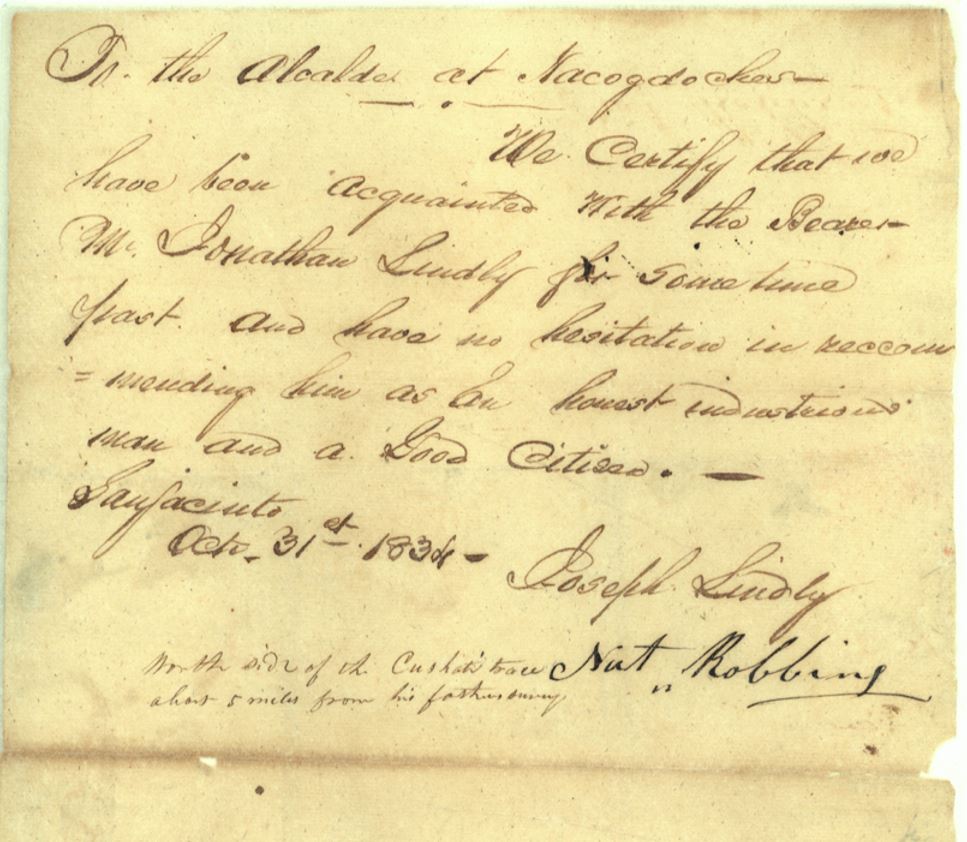
There are three documents in particular that I would like to share; the first being a letter of recommendation from 1834, and the other two bounty land grants awarded posthumously to Jonathan Lindley for bravely defending the Alamo with his life.

The first document shown is a letter of recommendation written on 31st of October 1834 stating that Jonathan was an "honest industrious man and and a good Citizen."  The Mexican government required letters of recommendation from reliable citizens before a man could enter Texas and obtain land.  Since Jonathan was already in Texas in October 1834, this was probably a requirement in obtaining a land grant.  Jonathan's father, Samuel W Lindley, received a letter of recommendation before entering Texas, which can be seen here.  His brother-in-law, John Sadler, also received a letter of recommendation which is shown on the John Sadler post.

Jonathan Lindley letter of recommendation
This second document is a bounty land certificate dated May 14, 1839, Houston, Texas.  Jonathan Lindley was awarded 1280 acres of land situated in Panola County, ten and one-half miles south, twenty degrees west from Carthage, Texas. It was patented March 9, 1860.  This document clearly states that Jonathan Lindley was "killed at the Alamo."
Jonathan Lindley Bounty Land Certificate 1280 acres
This third document is a bounty land certificate for 640 acres and states, "That Jonathan Lindley having been killed at the Alamo 6th March 1836 is entitled to six hundred and forty acres of Donation land..."
Jonathan Lindley Bounty Land Certificate 640 acres
These documents and other land records for Jonathan Lindley were found on The Texas General Land Office website.  In the past, I have spent many hours and many dollars at the Texas General Land Office in Austin searching for records and then having copies made.  Now the records can be found online -- for free:).  And, the resolution of the copies are much better than the xerox copies I had made.   From the home page of the Texas GLO (glo.texas.gov), click on the History tab, then the Land Grant Search tab.  The Research Links tab also has many useful links.


Monday, July 4, 2016

Happy 4th of July

Happy 4th of July!

Remember our Revolutionary War Ancestors

Click here to see a list of our ancestors who fought in the Revolutionary War or helped the cause of Freedom.


Saturday, June 11, 2016

Mary Jane Stewart Baldwin

Mary Jane Stewart Baldwin is my 2nd great-grandmother.  She was born October 3rd, 1872 in Nashville, Tennessee, the oldest daughter of Henry Stewart and Bettie Medlin.  The Stewart family eventually moved to Texas.  While living in Young County, Texas, Mary met a young man named Allen Baldwin.  They fell in love and were married in Graham, Young County, Texas on 22 Aug 1893.   Mary and Allen lived in Eliasville, probably near the Baldwin family, until about 1899.  Then after living in Throckmorton, Texas for a few years, Mary and Allen moved to Kiowa County, Oklahoma in 1904 and lived near the Mary's family - the Stewarts.  Allen died on June 5, 1931 in Fort Cobb, Oklahoma.  Mary moved back to Kiowa County and lived in Mountain Park with her widowed daughter Etta Barker.  Mary died in 1959.

Earliest known photo of Mary Jane Baldwin is in 1904.  She is standing in a doorway next to her mother Bettie Stewart.  The young boy standing down on the left is probably Grandpa Jess.
Bettie Stewart - Mary Baldwin
Jess Baldwin
The below photo is of the Allen and Mary Baldwin Family.  Left to Right: Tom Baldwin, Clyde Baldwin, Charlie Baldwin, Jess Baldwin, ?daughter Mattie?, Allen Baldwin, Mary Jane Stewart Baldwin.  Photo taken about 1925 to 1927 in Mountian Park, Oklahoma.

Allen and Mary (Stewart) Baldwin Family

Here is a colorized version of Mary from the above family photo.
Mary Stewart Baldwin

More information about the Allen and Mary Jane Stewart and all of their family can be found here and here.

Mary Jane Baldwin's Obituary was found in the Lawton Constitution (Newspaper), Lawton, Oklahoma, 22 Nov 1959.

Mrs. Mary Baldwin
Snyder (Special)
Services for Mrs. Mary J. Stewart Baldwin, 77, Kiowa county pioneer, were held at the Mt. Park Baptist church Saturday. Rev. John Matthieson officiated.
Burial was in Mt. Park Cemetery with Preston-Leckie funeral home in charge.
Born Oct. 3, 1872, in Nashville, she moved to Graham, Tex., as a child. She was married in Graham to Allen H. Baldwin. They moved to Oklahoma in 1904 and settled on a farm in Richland community. She was a member of the Baptist church.
Survivors include four daughters, Mrs. Etta Barker and Mrs. Maudie Killian, both of Mt. Park; Mrs. Betty Miller, Lancaster, Calif., and Mrs. Mattie Mitchell, Stratmore, Calif; four sons, Jessie, Cortez, Colo.; Charlie, Corcoran, Calif.; Clyde, Lancaster, Calif., and Tom, Lodi, Calif. Other survivors include 55 grandchildren, 88 great grandchildren and 10 great-great grandchildren.

Mary was buried in Mountain Park Cemetery in Kiowa County, Oklahoma.

Mary Jane Baldwin Headstone
Photo by KiowaGal

To view Mary's Find-A-Grave Memorial Page, click here.


Related Posts:


Weldon Baldwin 1919-1953

Weldon A. Baldwin
1919-1953
Army Air Corps

Father - Husband - Son - Brother

Weldon Baldwin as a youth
Weldon Baldwin was my mom's oldest brother.  Since Weldon died when I was young, I have no specific memories of him. But, I have heard many stories of him over the years -- it seems that everyone loved Weldon.  His sister Esther adored him.  His brother-in-laws trusted him and liked being around him.  Weldon was a friend to all who knew him.


YOUTH
Weldon Albert Baldwin was born January 30, 1919 in Mountain Park, Kiowa County, Oklahoma. He was the oldest of fourteen children born to Jesse and Mabel (Leffel) Baldwin.  Weldon spent the first fifteen years of life living in Oklahoma.  

Weldon started school in 1925 in Fort Cobb, Caddo County, Oklahoma.  Below are two of his school enrollment cards.  Weldon was enrolled in school by his middle name of Albert in 1925.  In 1929, he was still enrolled on the school records as Albert, but in 1930 he was listed was Weldon Baldwin.
Albert Baldwin
1925 School Enrollment, Fort Cobb, Caddo, Oklahoma
Weldon Baldwin
1930 School Enrollment, Fort Cobb, Caddo, Oklahoma
While the family lived in Mountain Park, Weldon’s great-grandmother Betty Medlin Stewart lived with them, and a lot of extended family members lived close by -- aunts and uncles from both sides of the family.  
  
Baldwin Family 
L-R: Weldon, Joe, Jess, Mabel, Sue, Ethel
Esther in front with cute hat.

The Great Depression was taking a toll on Weldon's family in Oklahoma. It was hard for his father Jesse to feed and care for the growing Baldwin family.  In addition, Jesse did not like living with the threat of tornadoes.  Jesse’s uncle, Charley Stewart, talked Jesse into moving to Gilbert, Arizona.  Charles Stewart had citrus groves and cotton fields and needed help. So Jess and Mabel sold their home in Oklahoma and moved to Arizona right after their daughter, Verna, was born in 1934.  Once they were living in Arizona, Weldon was old enough to help his family by working in the orange groves and cotton fields.

The Baldwin family lived in Arizona several years, before moving to Summit Point, San Juan County, Utah. Summit Point was located on the Utah–Colorado border.  Grandma Baldwin's brother, Lane Leffel, who had previously homesteaded in Southwestern Colorado, encouraged them to move into the area.

Below are photos of Weldon and his friend, Crock, when they were teenagers living at Summit Point.  Arthur "Crock" Cressler was Weldon's neighbor and friend.  Crock said of Weldon: "I never met a man as upstanding and true to his word as Weldon."  
Weldon's sisters said he had a pair of pants that looked looked like sailor pants and he would wear them all the time.  It looks as if Weldon had his "sailor pants" on when the below photos were taken.  Cute:)
Weldon (right) and friend, Crock.

Weldon (left) playing accordion, Crock playing guitar
  
Weldon on Horse

Weldon was musically gifted.  He could sing and play an accordion, guitar, saxophone, and piano.  In a photo above, he's playing his accordion.   
While living at Summit Point, Weldon was mentioned several times in the Monticello, Utah newspaper -- The San Juan Record.  Below is an article that mentioned some car trouble he had while returning home from a dance with his friends.  

San Juan Record, 8 Sep 1938

Marriages and Military
After living in Summit Point for several years, Weldon's family moved to Montrose, Colorado.  It was there that Weldon met Louise Hotchkiss.   Their marriage record is found in Clark County, Washington for the 6th of July 1942.  Two children were born to Weldon and Louise.  Weldon moved his family to Yamhill County, Oregon.  On 7 Oct 1942, he enlisted in the Army and soon left for basic training.  After Weldon was away serving in the war, Louise took their children and left them early one morning on the steps of the court house.  The children were placed in foster care.  After the war, Weldon returned home to find his children gone.  On 6 June 1947, Weldon was granted a divorce on grounds of cruelty by wife Louise.  With the help of his sister Esther, Weldon found his children.  Esther eventually adopted the children.   
Oregon State Archives, Divorce Records

After joining the Army, Weldon was sent to basic training in San Antonio.  He was trained to be a pilot for the Army Air Corps.  After he completed his training as a navigator for B17's,  he was made an instructor for pilots.  According to different family members, Weldon was an instructor at Fort Hood and also at a military base at Sioux City, Iowa.

The US Army Air Corps was the military aviation arm of the US Army during WWII and was the forerunner of the US Air Force.


Weldon's sister Esther introduced him to one of her friends named Nancy Jane Tingstrom, a native of California.  In about 1948, Weldon married Nancy in California. They had one daughter.
Weldon and Nancy - Wedding Day

Weldon Baldwin Family

Weldon continued to fly airplanes after the war ended and he returned home to civilian life.  He and a friend, Alan Thomas, started flying supplies into Alaska. In September 1948 while flying an empty cargo plane back to Portland, they had a plane crash. His co-pilot died and Weldon almost froze to death before he was rescued.
28 Sep 1948; Oregonian newspaper

In another business venture, Weldon is said to have invented a fork-lift and obtained a patent for the fork-lift.  But, I have not been able to find a patent in his name.  After Weldon died, his brother Joe sold the fork-lift business.

Weldon Baldwin

Weldon and a friend started a business to investigate airplane failures and crashes for the military and insurance companies.  Below are photos of Weldon transporting airplanes.


Died in a Flaming Truck Crash
In 1953, Weldon was hauling airplane parts on a flat-bed trailer behind his truck when he was hit head-on by a car trying to pass a logging truck.  Weldon's truck exploded during the crash and he was burned over 80% of his body.  Six days later on July 31, 1953, Weldon died in a Eugene hospital from injuries and burns caused by the accident.
Weldon's truck after the crash
Newspaper articles about the crash

The Oregon Statesman (Salem, Oregon) 26 July 1953

Eugene Guard newspaper, 31 July 1953

Weldon's obituary was placed in the Ventura County (California) 
Oxnard Press-Courier on August 3, 1953.


Funeral program for Weldon

Weldon was only thirty-four years old at the time of his death.  
He had lived an extraordinary life in a short time. 

Weldon Baldwin (Colorized and Repaired)


WELDON A BALDWIN
1919-1953
Army Air Corps
Father - Husband - Son - Brother


To view Weldon's Find-A-Grave Memorial Page, click here.


Tuesday, June 7, 2016

Henry R Stewart Civil War Pension II

For part 1, see previous post: Henry R Stewart Civil War Pension 

Henry's health declined to the point that in 1912, Henry left Oklahoma and traveled to the Army Hospital in Hot Springs, Arkansas.  He died in the Army Hospital on 19 September 1912. Henry R. Stewart is buried in the Little Rock National Cemetery in Little Rock, Arkansas.

Henry's widow, Bettie Medlin Stewart, applied for a Widow's pension.  The papers Bettie had to provide in order to receive her pension are rich in clues and/or information about her early life.  Bettie had told her grandchildren and great-grandchildren that she was an orphan and did not know anything about her family.  But, she provided the pension board just enough information that her family was found.  Blog posts about Bettie can be found here and here.


Widow's Pension 
Widow's Pension 

Widow's Pension 

Widow's pension 

Widow's Pension 
Widow's Pension 
Below is an affidavit by Bettie's brother-in-law,  J M Stewart.
Widow's Pension - JM Stewart Letter1
Widow's Pension - JM Stewart Letter2

Bettie stated that in 1870 she was living with "William Brown his wife Emma Brown and their children names were Clerry Jane Brown, Permela Brown and Smith Brown in Putnam Co., Tenn."  William A. Brown wrote a letter that is included in the pension file.
Widow's Pension - WA Brown Letter1

Widow's Pension - WA Brown Letter2

Henry R Stewart Civil War Pension

I have written several posts about my 2nd great-grandfather, Henry Riley Stewart.
Henry Stewart - Civil War Veteran
Old Stone House
Our Family Blacksmiths
Stewarts of Putnam County, Tennessee
Henry R Stewart Civil War Pension II

Henry was born 10 Dec 1843, the third child of Harrison and Sarah (Brown) Stewart. In his pension application, Henry states that he was born in Double Springs, Jackson County, Tennessee.  On 31 December 1863 at Carthage, Tennessee, Henry enlisted in the Union Army as a private in D Company 1st Tennessee Volunteers, Mounted Infantry. His pension is File # 1244,834.  At the end of the war, Henry was discharged honorably from the army on 25 April 1865 at Nashville, Tennessee.  Below are a few pages from his pension file.

Henry R Stewart Pension 1

Henry R Stewart Pension 2

Henry R Stewart Pension 3

Henry R Stewart Pension 4


Henry R Stewart Pension 5
Below is the official death record found in the pension file for Henry Stewart. It is from the Army and Navy General Hospital, Hot Springs, Arkansas.  I
Henry R Stewart Pension 6 - Death Record 

Army and Navy General Hospital, Hot Springs, Ark., Jan. 25, 1914 To the Commissioner of Pensions, Dept of the Interior, Washington, D.C. The records of this hospital show that Henry R. Stewart late Private Co. D, 1st Tennessee Volunteer Infantry, died at this hospital at 11:30 am September 19, 1912. Diagnosis: "Prostatic hypertrophy with chronic cystitis". Immediate cause of death: "Hypertrophied prostate, retention of urine, pyonephrosis, left, and secondary pneumonia." F.A. Winter Lieut. Colonel Medical Corps, Commanding


The Army-Navy General Hospital at Hot Springs, Arkansas was the first combined general hospital for both U.S. Army and Navy patients in the nation. In the early 1800s, people believed that bathing in mineral waters had therapeutic value, which brought many people to the town of Hot Springs (Garland County). The groundwork for the hospital was proposed in 1882. $100,000 was approved for the building of a thirty-bed, joint military hospital, the first such effort in U.S. history. President Chester A. Arthur signed the bill in 1882. The Army-Navy Hospital opened to patients in January 1887 under the direct jurisdiction of the secretary of war. The 1880s version of the Army-Navy Hospital was made of red brick, slate, and wood. the hospital (as a federal facility) was one of the top five employers in Garland County.